BigML
With the BigML modules in Boost.space Integrator you can:
-
Create, update, list, retrieve, and delete the anomaly scores
-
Create, update, list, retrieve, and delete the centroids
-
Create, update, list, retrieve, and delete the predictions
-
Create, update, list, retrieve, and delete the topic distributions
-

Watch and retrieve the resources
To get started with BigML, create an account at bigml.com/accounts/register/.
The module dialog fields that are displayed in bold (in the Boost.space Integrator scenario, not in this documentation article) are mandatory!
Connect BigML to Boost.space Integrator
To connect your BigML account to Boost.space Integrator you need to obtain the API Key from your BigML account and insert it in the Create a connection dialog in the Integromat module.
-
Log in to your BigML account.
-
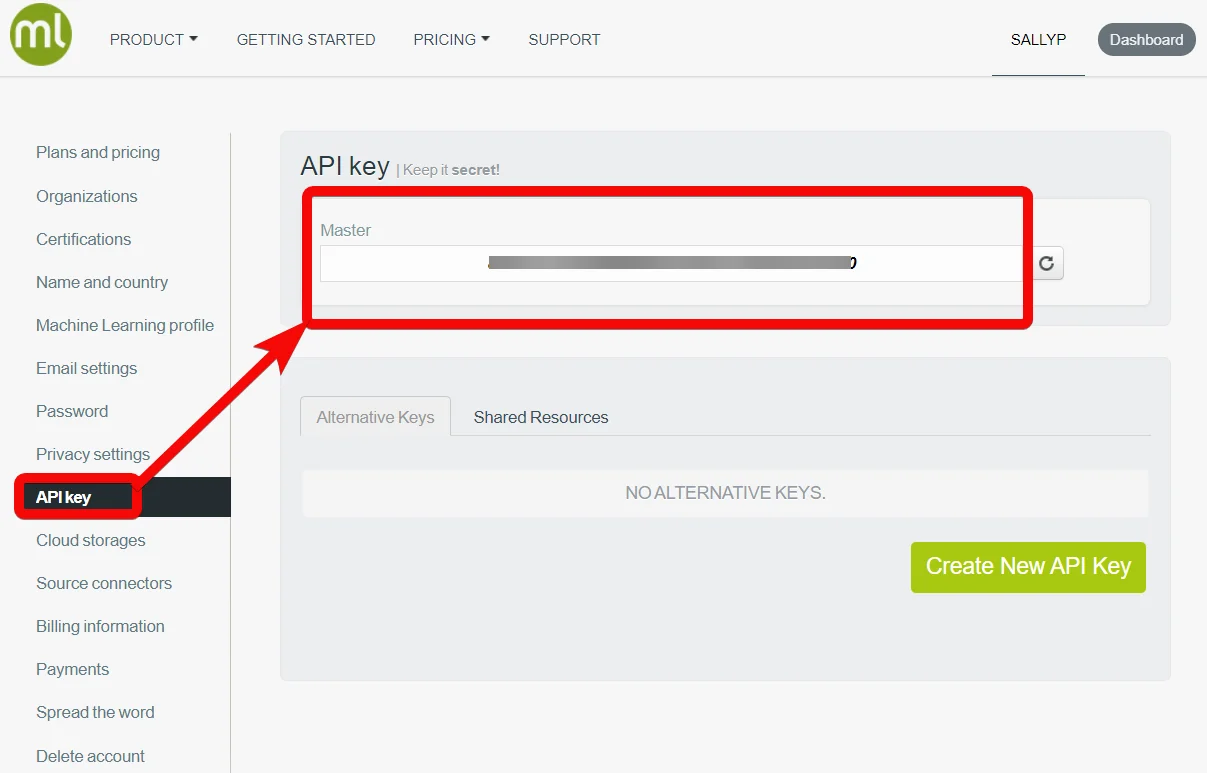
Click your username > API Key or go to the API Key link and copy the API key to your clipboard.
-
Log in to your Boost.space Integrator account and add a module from the BigML app into a Boost.space Integrator scenario.
-
Click Add next to the Connection field.
-
In the Connection name field, enter a name for the connection.
-
In the Username field, enter your BigML account’s username.
-
In the API Key field, enter the API Key copied in step 2, and click Continue.
You have successfully established the connection and can now create scenarios.
Anomaly Scores
You can create, update, list, retrieve, and delete the anomaly scores using the following modules.
List Anomaly Scores
Lists all anomaly scores.
Connection
Establish a connection to your BigML account.
Limit
Set the maximum number of anomaly scores Boost.space Integrator will return during one execution cycle.
Get an Anomaly Score
Gets a specified anomaly score.
Connection
Establish a connection to your BigML account.
Resource
Select or map the anomaly score resource whose details you want to retrieve.
Create an Anomaly Score
Calculates the anomaly score of a data instance.
Connection
Establish a connection to your BigML account.
Limit
Set the maximum number of anomaly scores Boost.space Integrator will return during one execution cycle.
Update an Anomaly Score
Updates an existing anomaly score.
Connection
Establish a connection to your BigML account.
Resource
Select or map the anomaly score resource whose details you want to update.
Name
Enter (map) a new name for the anomaly score.
Description
Enter (map) the anomaly score details.
Project
Select or map the project to which the anomaly score belongs.
Category
Select or map the category applicable to the anomaly score.
Tags
Add a list of keywords that help classify and index the anomaly score.
Delete an Anomaly Score
Deletes a specified anomaly score.
Connection
Establish a connection to your BigML account.
Resource
Select or map the anomaly core resource you want to delete.
Centroids
You can create, update, list, retrieve and delete the centroids using the following modules.
List Centroids
Lists all centroids.
Connection
Establish a connection to your BigML account.
Limit
Set the maximum number of centroids Boost.space Integrator will return during one execution cycle. The default value is 10.
Get a Centroid
Gets a specified centroid.
Connection
Establish a connection to your BigML account.
Resource
Select or map the centroid resource whose details you want to retrieve.
Create a Centroid
Finds out the closest cluster to your data instance.
Connection
Establish a connection to your BigML account.
Name
Enter (map) the centroid name.
Category
Select or map the category applicable to the centroid.
Description
Enter (map) the centroid details.
Project
Select or map the project to which the centroid belongs.
Tags
Enter (map) the tags that will help classify and index the centroid.
Do you want to attach webhook?
Select whether you want to attach a webhook to the centroid.
Update a Centroid
Updates an existing centroid.
Connection
Establish a connection to your BigML account.
Resource
Select or map the centroid resource whose details you want to update.
Name
Enter (map) a new centroid name.
Category
Select or map the category applicable to the centroid.
Description
Enter (map) the new centroid description.
Project
Select or map the project to which the centroid belongs.
Tags
Enter (map) the tags that will help classify and index the centroid.
Delete a Centroid
Deletes a specified centroid.
Connection
Establish a connection to your BigML account.
Resource
Select or map the centroid resource you want to delete.
Topic Distributions
You can create, update, list, retrieve, and delete the topic distributions using the following modules.
List Topic Distributions
Lists all topic distributions.
Connection
Establish a connection to your BigML account.
Limit
Set the maximum number of topic distributions Boost.space Integrator will return during one execution cycle. The default value is 10.
Get a Topic Distribution
Gets a specified topic distribution.
Connection
Establish a connection to your BigML account.
Resource
Select or map the resource whose topic distribution details you want to retrieve.
Create a Topic Distribution
Calculates all topic probabilities for a given document.
Connection
Establish a connection to your BigML account.
Topic Model
Select or map the topic model to create the topic distribution.
Name
Enter (map) the topic distribution name.
Description
Enter (map) the details of the topic distribution.
Project
Select or map the project to which the topic distribution belongs.
Category
Select or map the category applicable to the topic distribution.
Tags
Enter (map) the tags that help classify and index the topic distribution.
Do you want to attach webhook?
Select whether to attach the webhook to the topic distribution.
Update a Topic Distribution
Updates an existing topic distribution.
Connection
Establish a connection to your BigML account.
Resource
Select or map a resource whose topic distribution details you want to update.
Name
Enter (map) a new topic distribution name.
Description
Enter (map) the topic distribution details.
Project
Select or map the project to which the topic distribution belongs.
Category
Select or map the category applicable to the topic distribution.
Tags
Enter (map) the tags that help classify and index the topic distribution.
Delete a Topic Distribution
Deletes a specified topic distribution.
Connection
Establish a connection to your BigML account.
Resource
Select or map the resource whose topic distribution you want to delete.
Predictions
You can create, update, list, retrieve, and delete the prediction using the following modules.
List Predictions
Lists all predictions.
Connection
Establish a connection to your BigML account.
Limit
Set the maximum number of predictions Boost.space Integrator will return during one execution cycle. The default value is 10.
Get a Prediction
Gets a specified prediction.
Connection
Establish a connection to your BigML account.
Resource
Select or map the prediction resource whose details you want to retrieve.
Create a Prediction
Creates a prediction using a model, logistic regression, deepnets, etc.,
Connection
Establish a connection to your BigML account.
Create a Prediction Using
Select the option for creating the prediction:
-
Model
-
Logistic regression
-
Deepnet
-
Ensemble
-
Fusion
-
Linear regression
Name
Enter (map) the prediction name.
Description
Enter (map) the prediction details.
Project
Select or map the project to which the prediction belongs.
Category
Select or map the category applicable to the prediction.
Tags
Enter (map) the tags that help classify and index the prediction.
Do you want to attach webhook?
Select whether to attach the webhook to prediction.
Update a Prediction
Updates an existing prediction.
Connection
Establish a connection to your BigML account.
Resource
Select or map the prediction resource whose details you want to update.
Name
Enter (map) a new prediction name.
Description
Enter (map) the prediction details.
Project
Select or map the project to which the prediction belongs.
Category
Select or map the category applicable to the prediction.
Tags
Enter (map) the tags that help classify and index the prediction.
Delete a Prediction
Deletes a specified prediction.
Connection
Establish a connection to your BigML account.
Resource
Select or map the prediction resource you want to delete.
Resources
You can watch and retrieve the resources with the following modules.
Watch Resources
Triggers when a new resource is created.
Connection
Establish a connection to your BigML account.
Resource Type
Select or map the resource type you want to watch.
Limit
Set the maximum number of resources Boost.space Integrator will return during one execution cycle. The default value is 10.
Get a Resource
Gets a resource.
Connection
Establish a connection to your BigML account.
What to search
Select or map an option to search the resources:
-
Project
-
External Connector
-
Source
-
Dataset
-
Sample
-
Correlation
-
Statistical Test
-
Configuration
-
Composite
Resource ID
Select or map the resource ID whose details you want to retrieve a resource.
Other
Call any API using the following module.
Make an API Call
Performs an arbitrary authorized API call.
Connection
Establish a connection to your BigML account.
URL
Enter a path relative to https://bigml.io For example, /andromeda/deepnet
For the list of available endpoints, refer to the Big ML API Documentation.
Method
Select the HTTP method you want to use:
GET
to retrieve information for an entry.
POST
to create a new entry.
PUT
to update/replace an existing entry.
PATCH
to make a partial entry update.
DELETE
to delete an entry.
Headers
Enter the desired request headers. You don’t have to add authorization headers; we already did that for you.
Query String
Enter the request query string.
Body
Enter the body content for your API call.
Example of Use – List Projects
The following API call returns all the projects from your Big ML account:
URL:
/andromeda/projects
Method:
GET
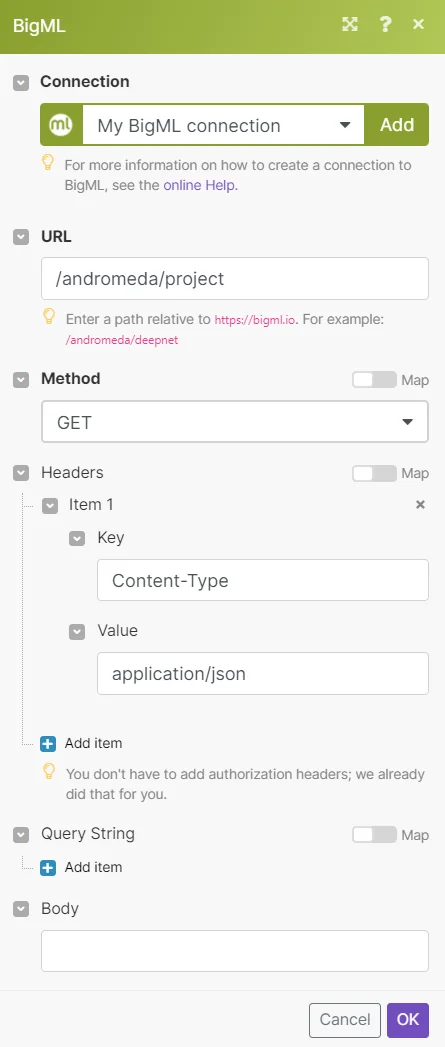
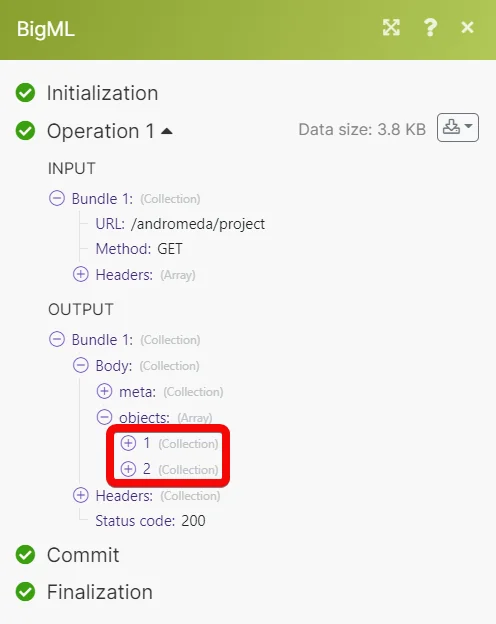
Matches of the search can be found in the module’s Output under Bundle > Body > objects.
In our example, 2 projects were returned:
Legacy article, imported from the original Boost.space knowledge base (/knowledge-base/applications/it-and-development/bigml/).

