New Relic
The New Relic modules allow you to create, update, list, and delete the deployments in your New Relic account.
Getting Started with New Relic
Prerequisites
- A New Relic account
In order to use New Relic with Boost.space Integrator, it is necessary to have a New Relic account. If you do not have one, you can create a New Relic account at newrelic.com/signup.
The module dialog fields that are displayed in bold (in the Boost.space Integrator scenario, not in this documentation article) are mandatory!
Connect New Relic to Boost.space Integrator
To connect your New Relic account to Boost.space Integrator you need to obtain the API Key from your New Relic account and insert it in the Create a connection dialog in the Boost.space Integrator module.
-

Log in to your New Relic account and open your Dashboard.
-
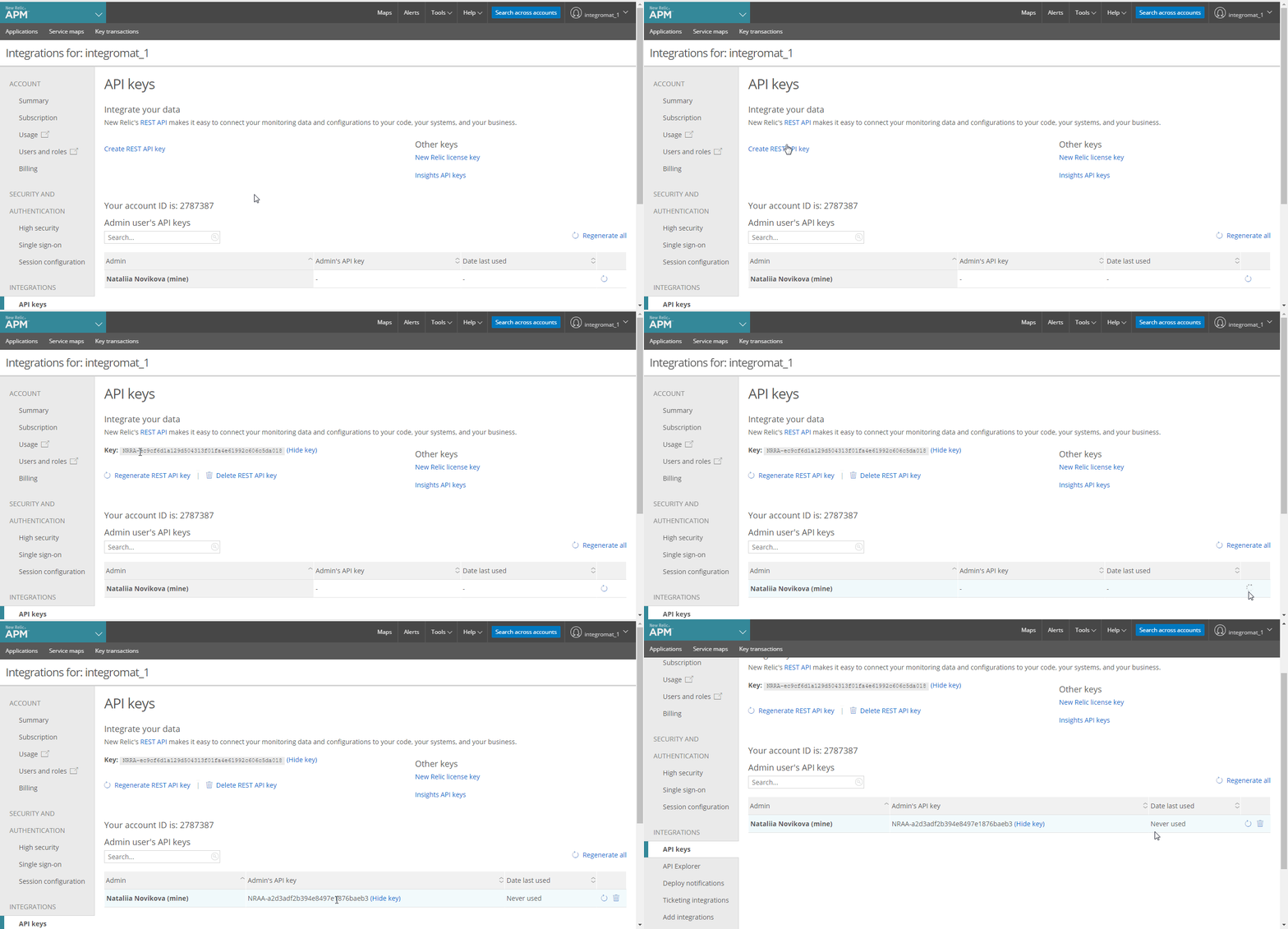
Click Your Profile Name > Account Settings > API Keys.
-
Click Create REST API Key > Show Key. In the Admin User’s API Keys section, click the Refresh (
 ) icon > Show Key. Copy the REST API key and Admin API key to a safe place.
-

Go to Boost.space Integrator and open the New Relic module’s Create a connection dialog.
-
In the Connection name field, enter a name for the connection.
-
In the REST API Key and Admin API Key fields, enter the keys copied in step 3 respectively.
-
Select whether your region is an EU Region and click Continue.
The connection has been established.
Deployments
Watch New Deployments
Triggers when a new deployment is created.
Webhook Name
Enter a name for the webhook.
Connection
Establish a connection to your New Relic account.
-

Open the Watch Deployments module, establish a connection, click Save, and copy the URL address to your clipboard. Click OK, Save, and run the trigger.
-
Login to your New Relic account, click Your Profile Name > Account Settings > Deploy Notifications. In the Webhook URL field, enter the URL address copied in step 1, and click Integrate with Webhooks.
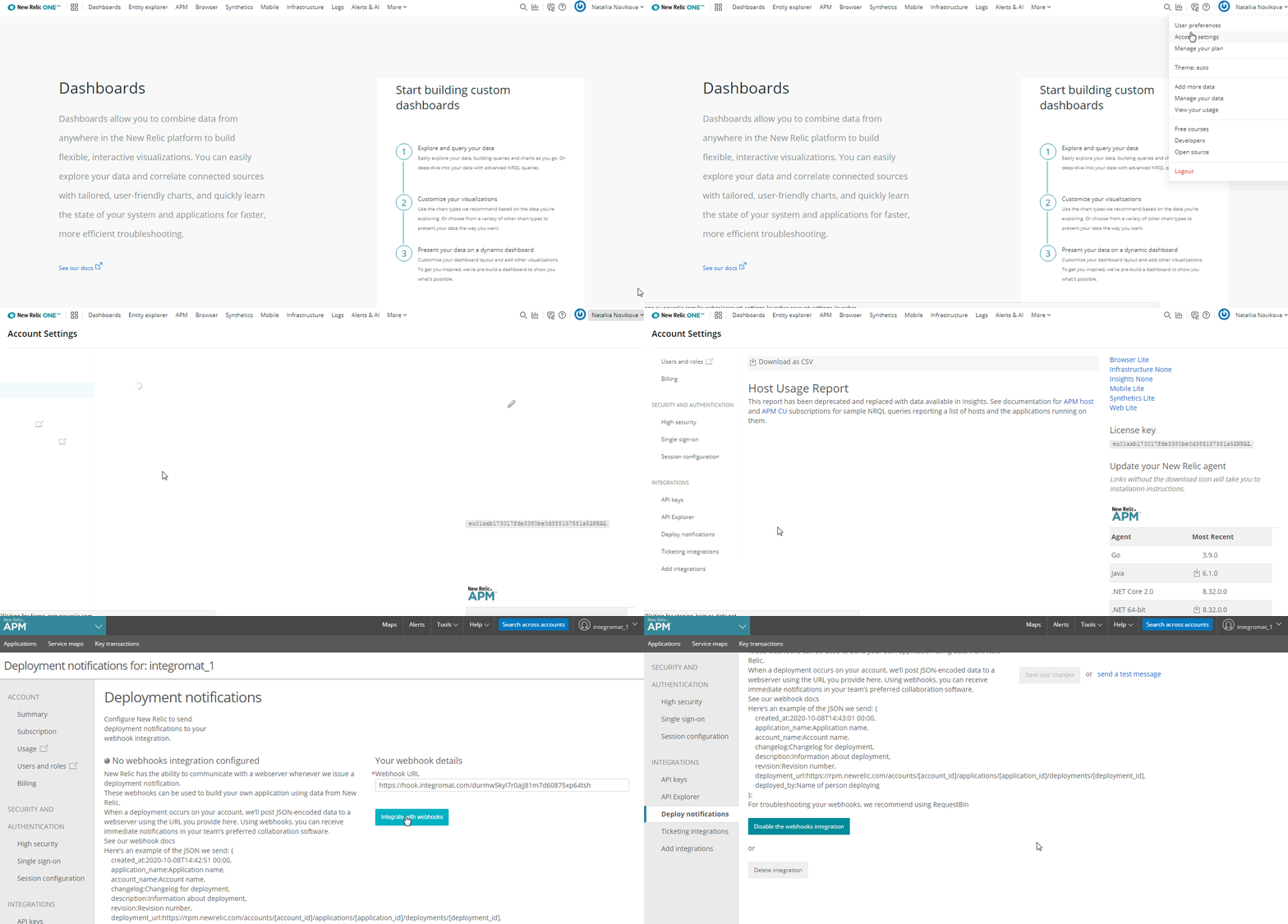
The webhook is successfully added.
List Deployments
Return a list of deployments.
Connection
Establish a connection to your New Relic account.
Application ID
Select the Application ID whose deployments you want to list.
Limit
Set the maximum number of deployments Boost.space Integrator should return during one scenario execution cycle.
Create a Deployment
Creates a new deployment.
Connection
Establish a connection to your New Relic account.
Application ID
Select the Application ID whose deployments you want to create.
Revision
Enter a revision number for the deployment. For example, 1.2
Changelog
Enter the changelog details of the deployment.
Description
Enter the details of the deployment.
User
Select the User ID who is creating the deployment.
Delete a Deployment
Deletes a deployment.
Connection
Establish a connection to your New Relic account.
Application ID
Select the Application ID whose deployment you want to delete.
Deployment ID
Select the Deployment ID you want to delete.
Other
Make an API Call
Performs an arbitrary authorized API call.
Connection
Establish a connection to your New Relic account.
URL
Enter a path relative to https://api.eu.newrelic.com/. For example: /v2/applications.json
For the list of available endpoints, refer to the New Relic API Documentation.
Method
Select the HTTP method you want to use:
GET
to retrieve information for an entry**.**
POST
to create a new entry.
PUT
to update/replace an existing entry.
PATCH
to make a partial entry update.
DELETE
to delete an entry.
Headers
Enter the desired request headers. You don’t have to add authorization headers; we already did that for you.
Query String
Enter the request query string.
Body
Enter the body content for your API call.
Example of Use – List Deployments
The following API call returns all the deployments from your New Relic account:
URL:
/v2/applications/{application_id}/deployments.json
Method:
GET
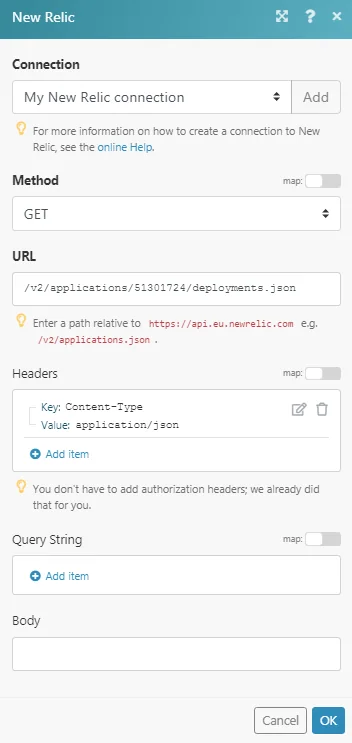
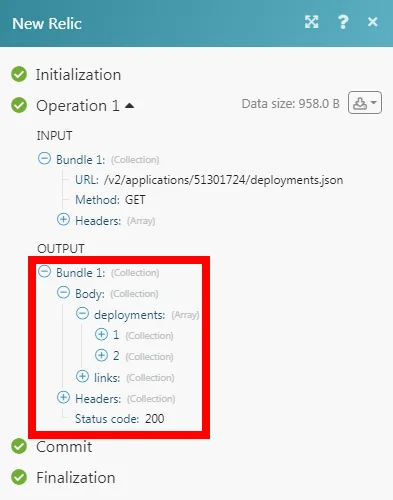
Matches of the search can be found in the module’s Output under Bundle > Body > deployments.
In our example, 2 deployments were returned:
Legacy article, imported from the original Boost.space knowledge base (/knowledge-base/applications/it-and-development/new-relic/).

